
"Reds for Red.
Reds for Life":
When science, football and the insurance sector come together to raise awareness on Ocean health and coral conservation
Defending Red to give a voice to corals and ocean life
Liverpool Football Club and AXA further expand their commitment to sustainability and 'Life Below Water' (United Nations' Sustainable Development Goal #14) through the 'Reds for Red initiative', launched on World Ocean Day and developed in partnership with the Tara Ocean Foundation.
Red is at the heart of Liverpool Football Club. It represents its identity and the passion it shares with its supporters. The 'Reds for Red initiative' is about leveraging the passion fans have to support the Reds to defend the Reds of the Ocean: coral reefs. For corals, their color embodies life and is a reflection of their vitality. Taking action to keep them vibrant and prevent bleaching events means preserving one of the richest ecosystems on our planet. The initiative aims to engage supporters and young generations through educational content and a unique experience.
A coral is a big colony working together. Coral reefs are protecting islands and coasts from erosions and are providing food for many communities on Earth. So they have a key role for the entire biodiversity. The opportunity to partner with a club like Liverpool FC, with such a huge audience, is actually very unique. It's really about finding how we can emotionally engage people into this action for coral conservation.
AXA and the Tara Ocean Foundation collaborated to create a 3D-printed coral sculpture illustrating the four stages of coral life and used to raise awareness on threats affecting corals, mainly global warming. The piece shows a healthy red coral that gradually turns white as a result of the stresses affecting the Ocean. It also conveys another essential message: when effective solutions are implemented to reduce pressures on marine life and protect ecosystems, some corals can recover their color and vitality.
Designed as an educational and engagement tool, this unique sculpture is intended to be deployed in a variety of awareness-raising activities such as the workshop held with Liverpool FC players and children. It helps explain the complexity and fragility of coral ecosystems while encouraging greater public awareness of ocean conservation. A card game around threats and solutions which draws a parallel between footballers and coral reef ecosystems can also be used in workshops.
Liverpool FC players, children and the coral sculpture — together for the Reds of the Ocean
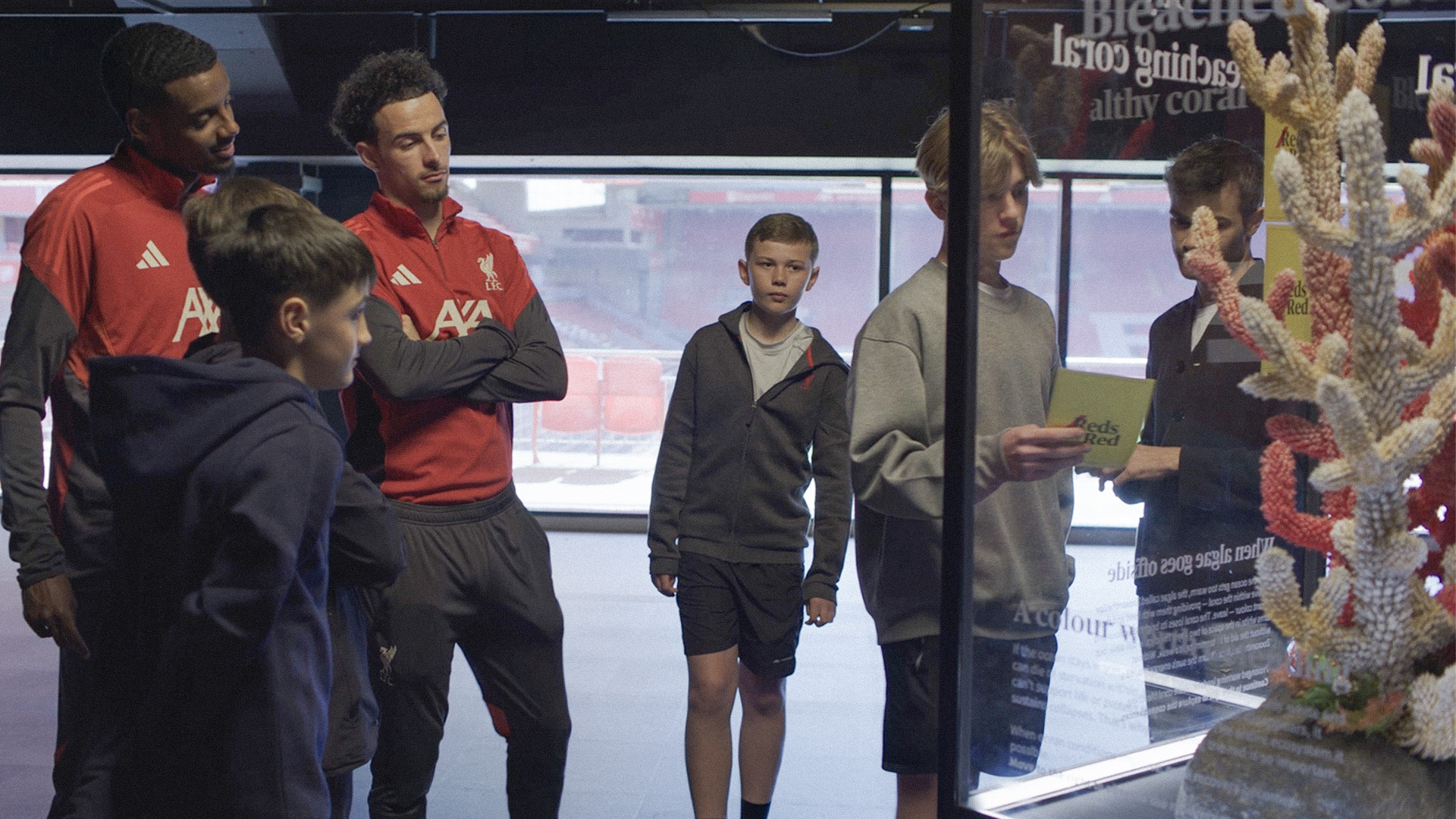


Curtis Jones, Alexander Isak, Beata Olsson, Sam Kerr and children taking part in the workshop led by Martin Alessandrini, Tara Ocean Foundation advocacy, who described the coral reef ecosystem and the threats it faces, and drew a parallel with the LFC community spirit and values.
Creating a connection with coral reefs to turn passion into action for ocean life
Coral reefs host about 25% of known marine biodiversity. As true oceanic oases, they offer refuge, food, and habitat, and provide numerous ecosystem services that support more than 500 million people. But they are facing both global pressures (rising temperatures, ocean acidification, sea-level rise) and local pressures (destructive fishing practices and overfishing, intensive coastal development, land-based pollution). It is estimated that between 30 and 50% of the world's coral reefs have been lost in the past forty years.
Unlike many other regions of the world where climate warming has triggered widespread coral bleaching, the reefs of the Coral Triangle have thus far maintained their coral cover. There is an urgent need to understand why and how certain corals withstand global warming to ensure that, by the end of the century, we are still able to observe these unique and essential ecosystems.
Learning from climate-resilient corals: Tara Coral, a major scientific expedition in the Coral Triangle
For 18 consecutive months, the scientific schooner Tara will navigate through the Coral Triangle in East Asia seas to unleash the secrets of climate-resilient corals. On board, 16 crew members (scientists from around the world, sailors, mediamen and artists) will study this unique biodiversity hotspot which hosts one-third of the world's coral reefs.
Their objective: to understand the mechanisms underlying the exceptional thermotolerance of certain types of corals and identify the corals of tomorrow. What scientists will discover could have a fundamental impact on conservation strategies around the world.
Find out more about Tara Coral expeditionHeadquartered in France, the Tara Ocean Foundation is a pioneering nonprofit organization dedicated to Ocean conservation. Inspired by the conviction of its founders, fashion icon agnès b. and her son Etienne Bourgois, that the Ocean is essential to life on earth, for over 20 years the Foundation leads a transformational movement to protect ocean life.
For several years now, AXA has been supporting the work of the Tara Ocean Foundation and its schooner around the world. As a major partner of the foundation and a sponsor of Liverpool Football Club, AXA is bringing these two worlds together to raise awareness of coral conservation.