Skip to content
    Tara Coral

    Tara Coral:assessing coral resistance in the Coral Triangle

    In most regions of the world, climate change has caused massive coral bleaching. But in the Coral Triangle, at the heart of the western Pacific, a third of the planet's coral reefs have resisted so far. For 18 months, the schooner Tara will sail through this region to understand why. The goal: identify the resilience mechanisms behind these corals to inform tomorrow's conservation strategies. The data will be openly accessible.

    Discover the schooner Tara
    18 months
    at sea across 30,000 nautical miles
    67
    scientists from more than 40 international partners
    10 sites
    sampled across the Coral Triangle
    © Maéva Bardy / Tara Ocean Foundation

    What bleaching doesn't tell us

    Around the world, warming has triggered massive coral bleaching. In the Coral Triangle, a third of the planet's reefs have resisted so far, and no one can yet explain why.

    What Tara Coral will deliver

    Eighteen months at sea, 67 scientists, 10 sampling sites and an open database to identify the resilience mechanisms behind the most resistant corals.

    You can't reproduce a mechanism you don't understand.

    Around the world, reef conservation strategies today mostly focus on slowing decline, because no one yet knows why some corals resist while most bleach. Without understanding that mechanism, there's no way to reproduce it elsewhere.

    The Tara Coral expedition was designed to change that. Concretely, your donation funds:

    18 months of expedition with 67 international scientists

    The onboard CBASS (Coral Bleaching Automated Stress System), which tests coral resistance at four levels of heat stress

    Standardised protocols and an open-access database to inform global reef conservation strategies

    A region that resists, while the rest of the world bleaches

    Coral reefs cover just 0.2% of the ocean's surface, yet they host 25% of all known marine biodiversity. They sustain hundreds of millions of people and provide ecosystem services that UNEP values at US$2.7 trillion a year. Today, more than 40% of coral species are threatened with extinction, under the combined pressure of global threats (rising temperatures, ocean acidification, sea level rise) and local threats (overfishing, pollution, coastal development).

    Almost everywhere, this pressure has translated into massive reef bleaching. Except in one specific area: the Coral Triangle. This region, spanning 5.7 million km² across 6 western Pacific countries, holds a third of the world's coral reefs and three-quarters of known coral species, around 600 different species. And unlike other regions of the globe, its reefs have largely kept their coral cover despite the warming.

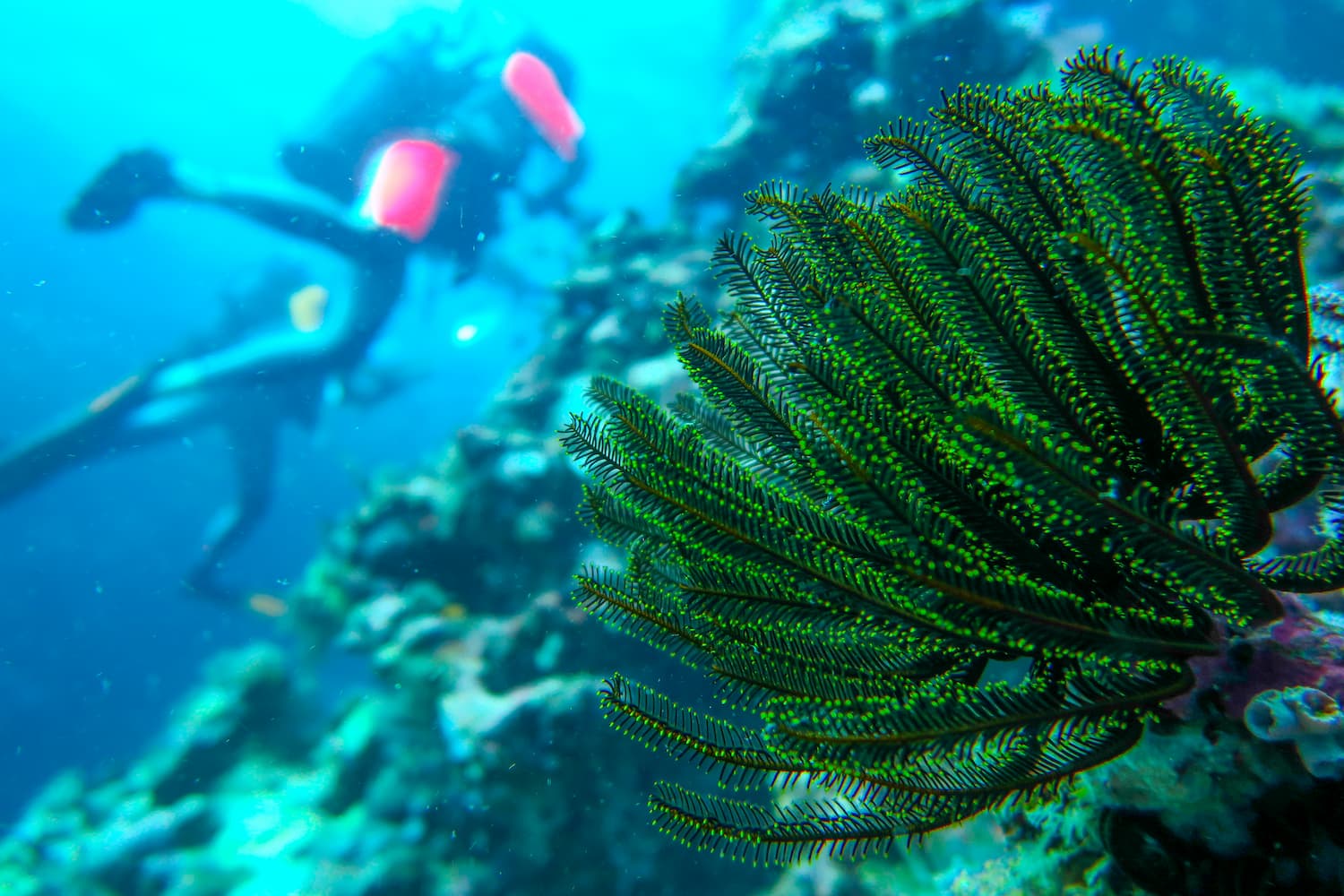
    Coral reef biodiversity in the Solomon Islands
    © Vincent Hilaire / Tara Ocean Foundation

    A natural laboratory for understanding resilience

    This contrast matters: it makes the Coral Triangle a unique natural laboratory for understanding how some corals resist where others die. Ten years after the Tara Pacific expedition (2016-2018), which documented the scale of reef decline worldwide, Tara Coral shifts approach. The goal is no longer just to measure decline, but to uncover the resistance mechanism itself.

    The expedition will test several hypotheses in parallel: greater diversity of organisms within ecosystems, the presence of naturally more resistant species, a selection of individuals pre-adapted to climate change due to their local climate history, or an upwelling of cold water at depth (micro-upwelling) that could locally reduce heat stress.

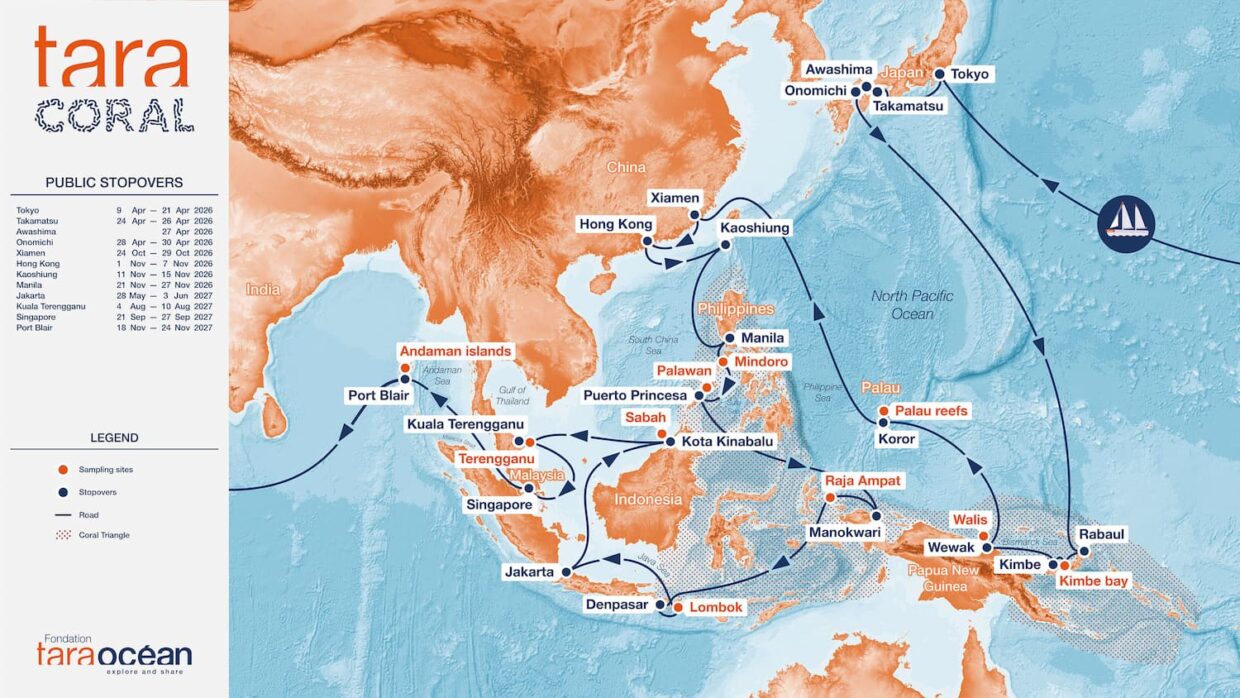
    Map of the Tara Coral expedition route across the Coral Triangle
    © Tara Ocean Foundation

    Key figures

    0.2%

    the share of the ocean's surface covered by coral reefs, hosting 25% of known marine biodiversity

    5.7 million km²

    the size of the Coral Triangle, across 6 western Pacific countries

    44%

    the share of reef-building coral species threatened with extinction (IUCN Red List, November 2024)

    1,440

    scientific dives planned, across 10 sampling sites and 26 port calls

    18 months, 30,000 nautical miles, an unprecedented scientific method

    From 2026 to 2028, a crew of 16 (6 sailors, 8 scientists, 1 artist and 1 onboard correspondent) will sail 18 consecutive months across the Coral Triangle, covering 30,000 nautical miles (over 50,000 km), with 26 port calls across 6 countries and 35 days spent at each of 10 sampling sites.

    Teams will focus on 4 key coral genera (Acropora, Millepora, Porites and Pocillopora), following a field protocol organised in 4 parts: describing the reef's environmental context (environmental DNA sampling and 3D photogrammetry), characterising the complexity of the coral holobiont (the coral and all the micro-organisms living with it), testing heat stress resistance using a unique onboard system, CBASS, which exposes coral fragments to four temperature levels to identify resistance biomarkers, and finally analysing colony geochemistry to reconstruct their climate history.

    This expedition brings together 67 scientists (22 women, 45 men) from more than 40 international partners, including 11 from the Coral Triangle itself.

    Scientific dive in the Solomon Islands
    © Vincent Hilaire / Tara Ocean Foundation

    What this expedition will actually change

    The expected results go well beyond scientific publication. Tara Coral will produce an open database, protocols that can be standardised elsewhere in the world, and direct expertise transfer to local stakeholders (scientists, managers, policymakers, educators). Science-to-policy workshops will be held at every port call to identify and prioritise the protection of the most resistant reefs. In the longer term, the goal is to learn how to reproduce, elsewhere, the conditions that allow a coral to resist.

    © Agathe Roullin / Tara Ocean Foundation

    The only place in the world where corals are still resisting on a large scale.

    The Coral Triangle holds a third of the world's coral reefs and three-quarters of known coral species, across a region spanning 6 western Pacific countries. Unlike the rest of the globe, its reefs have largely kept their coral cover despite ocean warming. This expedition brings together 67 scientists from more than 40 international partners, 11 of them from the Coral Triangle, and plans 1,440 scientific dives across 10 sites, with 35-day stays at each. It is co-led by Paola Furla (Université Côte d'Azur), Serge Planes (EPHE, CNRS) and Christian R. Voolstra (University of Konstanz). For over 20 years, the Tara Ocean Foundation has run scientific expeditions in partnership with leading international research laboratories and holds United Nations Special Observer status.

    « The time is no longer only for documenting trends and the decline of coral reefs. »

    Serge Planes, scientific director of Tara Coral, CNRS research director

    Scientific partners

    CNRSUniversité Côte d'AzurUniversity of KonstanzEPHE

    Follow the Tara Coral expedition

    An onboard correspondent tells the story of the expedition, port call after port call. Images, scientific results and field stories, straight to your inbox.

    Frequently asked questions

    It directly funds the Tara Coral expedition: the schooner Tara's 18-month voyage, onboard scientific equipment (including the CBASS heat-testing system), the scientific team and crew's salaries, and the open-access distribution of the collected data.
    Because it's the only major reef region where coral cover has remained relatively stable despite ocean warming. It's a unique natural laboratory for understanding coral resistance mechanisms, rather than simply observing decline.
    It's an onboard system that exposes coral fragments to four different temperature levels (no stress, low, moderate and high stress) to identify the most heat-resistant colonies and detect their resistance biomarkers.
    Tara Pacific documented, on a large scale, the decline of coral reefs facing climate change. Tara Coral shifts the angle: it focuses on a specific area where corals are resisting, to understand the resistance mechanism itself rather than the decline.
    Yes, if you're a French tax resident: 66% of your donation is deductible from your income tax (up to 20% of your taxable income), or 75% if you're subject to the IFI wealth tax (capped at €50,000 in tax relief per year, meaning a maximum donation of €66,667).
    18 consecutive months between 2026 and 2028, with 26 port calls across 6 western Pacific countries and 35 days spent at each of the 10 planned sampling sites.

    Fund 18 months of expedition across the Coral Triangle

    Your donation funds the only programme trying to understand why these reefs resist, instead of simply measuring their decline.

    Donations are 66% deductible from French income tax, or 75% under the IFI wealth tax. Tax receipt sent automatically.

    Discover the schooner Tara